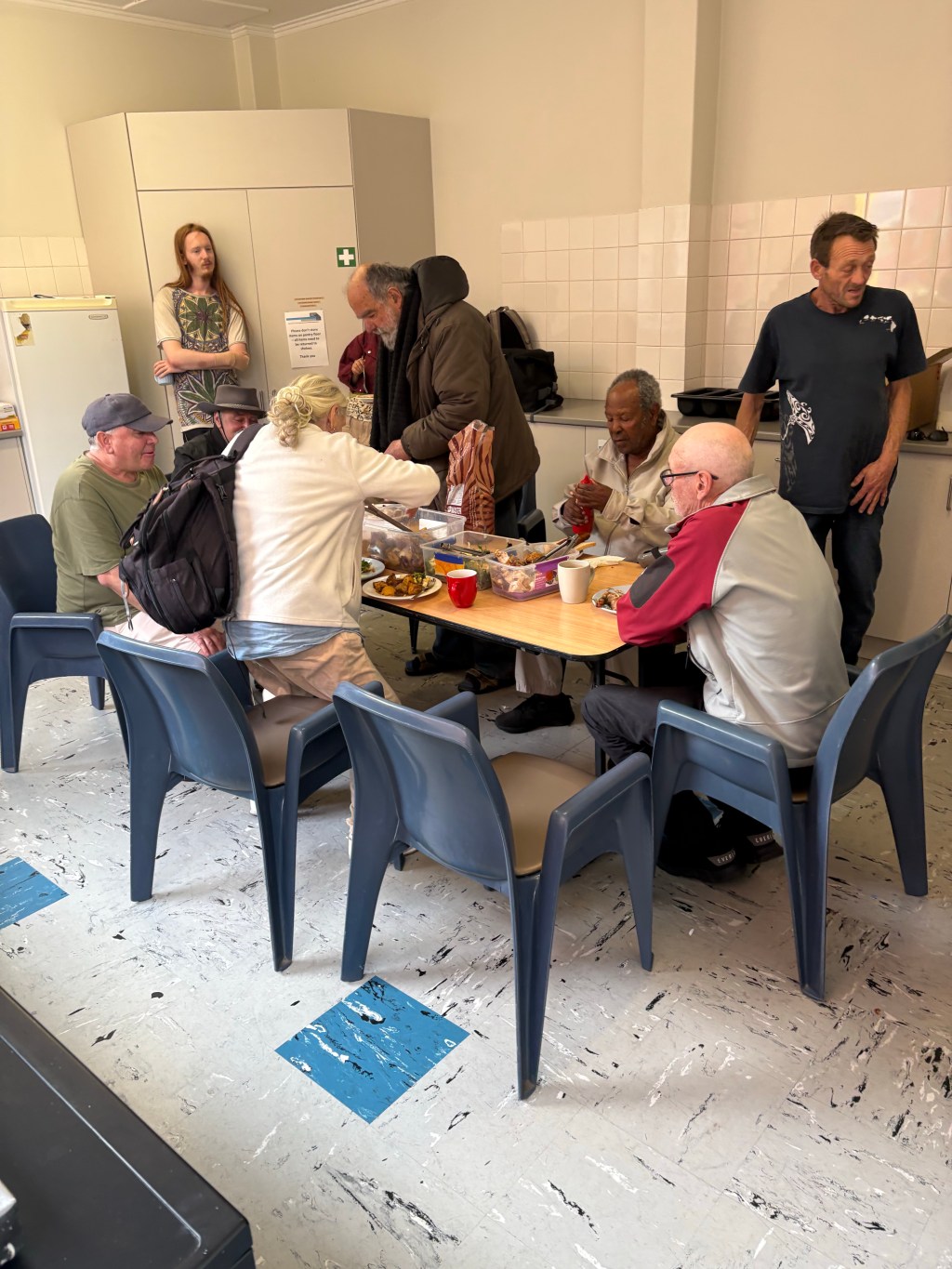
One of the most significant developments within Food Not Bombs Hobart has been the creation of the Shared Table.
Today it may appear simple: people sitting together and sharing a meal. In reality, the Shared Table emerged gradually over several years of experimentation, observation, and persistence. It required challenging assumptions about how community food programs operate and what genuine inclusion looks like.
The concept is based on a family dinner-style approach. Rather than distributing food to people who then separate into different groups, the Shared Table intentionally brings people into closer proximity. Volunteers, rough sleepers, community members, visitors, donors, and organisers are all invited to sit together, eat together, and participate in the same social space.
This approach is often met with resistance by outsiders until they try it.
Many people are comfortable with models that maintain distance between those providing support and those receiving it. Shared dining removes some of those boundaries. It asks people to engage with one another as neighbours rather than categories. For individuals accustomed to authority, professional roles, or traditional service structures, this can sometimes feel uncomfortable or unfamiliar.
The Shared Table is not always easy to facilitate. It requires volunteers who can navigate complex social dynamics, welcome newcomers, manage tensions, encourage participation, and create an environment where everyone feels respected. The closer people become, the more important these skills become.
Yet the rewards are substantial.
At its best, the Shared Table creates opportunities for conversations that would otherwise never occur. Friendships form between people from vastly different backgrounds. Stories are exchanged. Trust develops. People become visible to one another not as clients, volunteers, professionals, donors, or rough sleepers, but as human beings sharing a meal.
The table becomes more than a place to eat. It becomes a place of belonging.
Many people who strongly identify with the values of Food Not Bombs Hobart recognise the Shared Table as one of the organisation’s most distinctive and powerful practices. It reflects a belief that community is not built simply by providing food. Community is built through relationship, participation, and the willingness to share space with one another.
In a society where loneliness, division, and social isolation are increasingly common, gathering around a shared table can be a surprisingly radical act.
- Homeless Support Matteress
- Meet Our Tassie Tiger: Carved Wooden Mascot – Giver of Hope
- Meet Our Wombat: Carved Animal Mascot – The Provider
- StreetShelter: A Reflection on Shelter, Dignity and Mutual Aid
- Welcome to Food Not Bombs Hobart

 Food Not Bombs Hobart
Leave a comment